

For most churches in 2026, custom-branded NFC tap discs cost between $3.50 and $5.00 per unit as a one-time purchase, with no monthly or transaction fees. This guide breaks down the exact hardware costs, hidden platform fees, and long-term ROI to help you budget accurately. We will cover the true price of tap-to-give hardware, how to calculate your total investment, and why one-time costs beat subscription models for long-term financial health.
Custom Branding Costs
Custom branding is the visual identity of your giving hardware, and it is often the first thing a donor sees. A custom-branded NFC plate is a physical disc printed with your church's logo, colors, and specific giving instructions. At Tap.Giving, every order includes a custom-branded design proof built from your existing logo and color palette. This service is included at no extra charge, meaning you do not need to hire a separate design agency to make the hardware look professional.
The cost of branding is typically bundled into the per-unit price of the hardware. When you order from a specialized provider, the design process is streamlined. You upload your assets, and the provider generates a proof for your review. This ensures the final product matches your sanctuary's aesthetic. Because the design is part of the manufacturing process, there is no separate line item for "design fees" on your invoice. This transparency helps finance committees understand exactly where the budget is going.
Design Proof and Approval
Before any manufacturing begins, you will receive a digital proof of your plate. This step is critical for ensuring accuracy. You can request changes to the layout, font, or color scheme during this phase. Most providers, including Tap.Giving, handle these revisions quickly, often within the same day. This iterative process ensures that the final hardware reflects your brand identity perfectly without incurring additional design costs.
Hardware Pricing Tiers
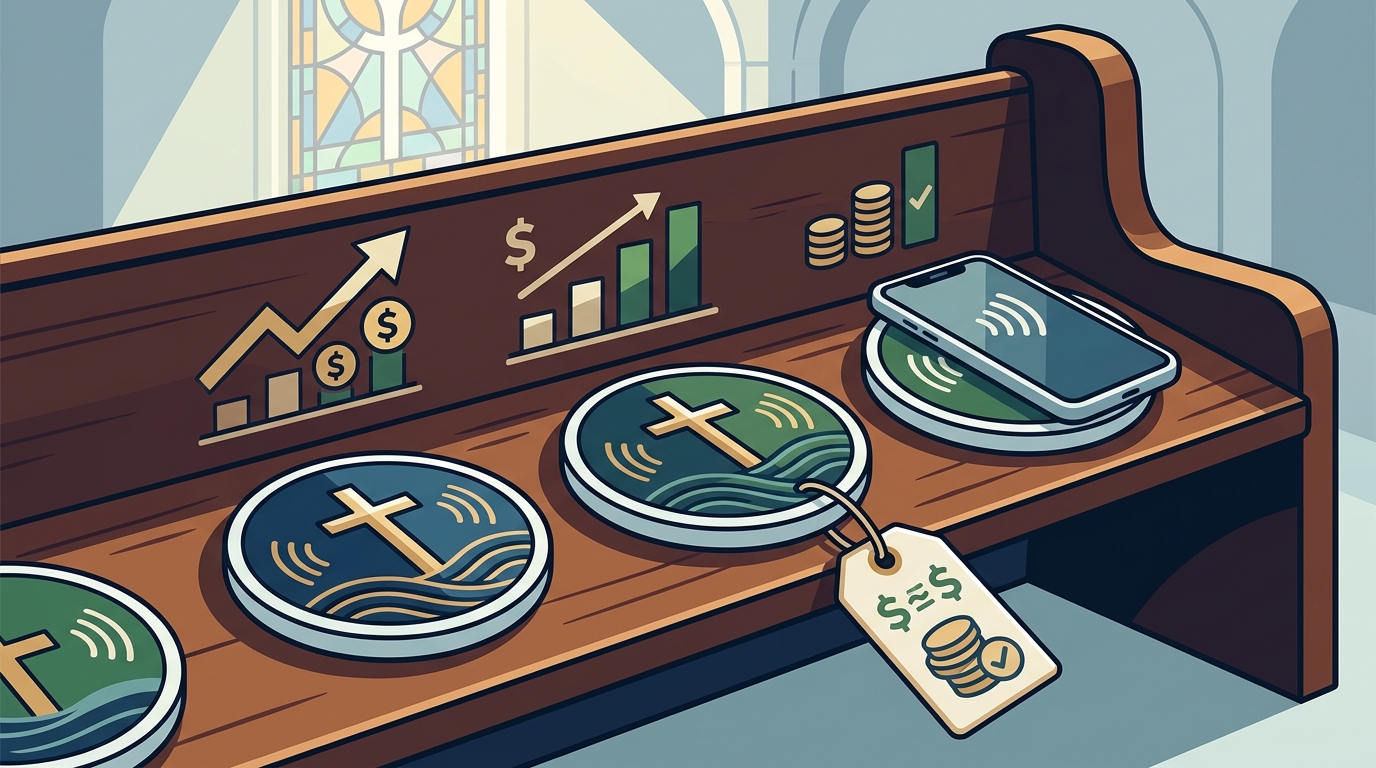
Hardware pricing for NFC tap discs usually follows a volume-based model. The more units you order, the lower the cost per disc. This structure rewards churches that equip their entire sanctuary at once. For example, a starter package of 100 discs might cost $5.00 each, while a bulk order of 400 or more discs drops to $3.50 each. This tiered approach allows smaller congregations to test the technology with a lower initial investment before scaling up.
It is important to distinguish between the hardware cost and the platform cost. The hardware is the physical NFC chip and PVC disc. The platform is the software where the donation is processed. When you buy hardware from a provider like Tap.Giving, you are paying only for the physical item. There are no setup fees, no monthly maintenance fees, and no transaction fees taken by the hardware vendor. The total cost for 100 discs at the starter tier is $500. This is a one-time expense that covers the entire lifespan of the hardware.
Volume Discounts and Savings
Hidden Fees and Platform Lock-In
Hidden fees are the most common trap in church giving technology. Many NFC solutions are not standalone; they are tied to a specific software platform. If you buy tap discs from a platform provider, you may be required to use their giving software. This creates a lock-in effect where you must pay ongoing subscription fees to keep the hardware functional. For instance, some platforms charge a monthly fee for the tap feature, or they only work if you are on a premium plan.
Platform lock-in means that if you decide to switch giving providers in the future, your existing hardware may stop working. This forces you to buy new hardware, duplicating your investment. In contrast, hardware-only solutions like Tap.Giving plates are programmed with a simple URL. This URL can be changed at any time. If you switch from one giving platform to another, you simply update the link on the existing discs. This flexibility eliminates the risk of stranded assets and ensures that your hardware investment remains valuable regardless of your software choices.
Transaction Fees vs. Hardware Fees
It is crucial to separate transaction fees from hardware fees. Transaction fees are charged by payment processors for handling credit card or bank transfers. These fees are standard across the industry and are not specific to NFC hardware. However, some hardware vendors add their own transaction fee on top of the processor's fee. Tap.Giving does not take a transaction fee. You pay the standard processing fee to your payment provider, but the hardware vendor takes nothing. This distinction is vital for accurate budgeting.
Five-Year ROI Analysis
Return on investment (ROI) is the measure of how quickly your hardware pays for itself. NFC tap discs have a very low break-even point because they reduce friction in the giving process. When donors can give in 15 to 30 seconds without downloading an app, participation rates increase. Higher participation leads to higher total giving. For a mid-size church, the $500 investment in 100 discs can be recouped in a single month if even a small percentage of the congregation uses the new method.
Over a five-year period, the cost of NFC hardware remains static. You pay $500 once, and the discs continue to work. In contrast, subscription-based giving apps can cost between $1,200 and $2,400 per year. Over five years, that is a total cost of $6,000 to $12,000. The difference is substantial. By choosing one-time hardware, you save thousands of dollars over the life of the product. This savings can be redirected to ministry, outreach, or other operational needs.
Long-Term Value and Durability
Durability is a key factor in long-term value. High-quality NFC plates are made from laminated PVC that is waterproof and dustproof. They are designed to withstand daily use in a church environment. Because they have no batteries or moving parts, they do not degrade over time. A well-maintained plate can last for many years. This longevity ensures that your initial investment provides value for the long term, rather than requiring frequent replacement.
Cost Comparison Table
The following table compares the five-year total cost of different giving technologies. This comparison helps you see the true financial impact of your choice.
| Technology | Upfront Cost | Monthly Fee | 5-Year Total Cost | Platform Lock-In |
|---|---|---|---|---|
| NFC Tap Discs (Tap.Giving) | $500 (100 units) | $0 | $500 | No |
| Giving Kiosk | $2,000 - $5,000 | $50 - $100 | $5,000 - $12,000 | Yes |
As the table shows, NFC tap discs are the most cost-effective option over a five-year period. The one-time nature of the cost makes it easy to budget and easy to justify to a finance committee. There are no recurring charges to track, and no risk of price increases from a vendor.
Key Takeaways
- Custom-branded NFC tap discs cost between $3.50 and $5.00 per unit, depending on volume.
- Design and branding services are typically included at no extra charge with hardware orders.
- There are no monthly fees, setup fees, or transaction fees charged by hardware-only vendors.
- Platform lock-in is a major hidden cost; hardware-only solutions avoid this by using simple URLs.
- Over five years, NFC hardware costs $500, while subscription apps can cost up to $12,000.
- Volume discounts save $1.00 per disc for orders of 400 or more units.
- NFC plates are durable, waterproof, and have no batteries, ensuring long-term value.
- The break-even point for NFC hardware is often reached within the first month of use.
Frequently Asked Questions
How much do NFC tap discs cost per unit?
NFC tap discs typically cost between $3.50 and $5.00 per unit. The exact price depends on the quantity ordered. Smaller orders of 100 units are usually at the higher end, while bulk orders of 400 or more are at the lower end.
Are there monthly fees for NFC tap discs?
No, hardware-only NFC tap discs do not have monthly fees. You pay a one-time cost for the hardware. However, you will still pay standard transaction fees to your payment processor for each donation received.
Do I need to pay for custom design?
No, custom design is usually included in the price of the hardware. Providers like Tap.Giving include a design proof and revisions at no extra charge. You do not need to hire a separate graphic designer.
What happens if I switch giving platforms?
If you use hardware-only NFC discs, you can simply update the URL programmed into the discs. This allows you to switch giving platforms without buying new hardware. This flexibility is a major advantage over platform-locked solutions.
How long do NFC tap discs last?
NFC tap discs are made from durable, laminated PVC. They have no batteries or moving parts, so they can last for many years. They are designed to withstand daily use in a church environment.
Is there a minimum order quantity?
Yes, most providers have a minimum order quantity, often 100 units. This ensures that the manufacturing process is efficient and that the per-unit cost remains low for the customer.
Conclusion
Understanding the true cost of NFC tap discs is essential for making an informed decision about your church's giving technology. The hardware itself is an affordable, one-time investment that offers significant long-term savings compared to subscription-based alternatives. By choosing a hardware-only solution, you avoid hidden fees, platform lock-in, and recurring costs. Tap.Giving provides transparent pricing, custom branding, and flexible hardware that works with any giving platform. To see your exact price and design your plates, start your order today.